One of the most telling points against the increasingly decrepit Alberta government of the late 1960s was that we were exporting raw coal to Japan and receiving only 10 cents per tonne in royalties. Peter Lougheed used this point to advantage to end 36 years of Social Credit rule and usher in his Progressive Conservative party. While there has been significant improvement in adding value in Alberta through, for example, development of a petro-chemical industry, far more could be done and it is to our embarrassment that we are still exporting huge quantities of crude oil and, yes, raw coal [2010 royalties amounted to 75 cents per produced tonne]. (1)
President Obama's scuttling of the Keystone XL pipeline could be a favour to Alberta if we respond to it as an opportunity to dramatically enhance our capacity to add value to our petroleum resources and end the short sighted policies of exporting our raw resources. [Canadian economic history is characterized by the over reliance on primary products: fish, fur, forest, and farm production exported in its raw form without consequent economic diversification and capital accumulation.] Alberta should respond with an immediate tax on crude oil exports to incentivize refinery and petro-chemical construction here, and encourage further tertiary production. The income from such a tax should be targeted to enhance our highways and streets, and reduce the provincial tax on diesel fuel and gasoline.
In the late 1960s, Albertans were proud to have the best highways in Canada. Bill Hawrelak swept into the mayor's chair in Edmonton on a promise to pave every street in Edmonton. [Exciting stuff to those of us who drove on the gravel trail through Jasper Place (today's 156 street)]. Today we are relieved if some of the major potholes have recently been patched, but we should be embarrassed it has come to this. We should also be embarrassed that more often than not gasoline can be bought in Toronto at a lower price than in Alberta (not to mention in Houston).
[As of this date Houston = 81.9 cents/liter vs Edmonton = 105.9 cents per liter]
These figures should cause us to ask why we should be so enthusiastic about supporting the Keystone XL pipeline which would export not only our crude oil but the consequent capital investment, job creation, and economic spin-offs to Houston rather than retaining all of these in Alberta.
It is surprising that the Wildrose has been such a vocal supporter of XL. A recent press release (2) claims that the XL pipeline somehow would reduce the gap between West Texas Intermediate and Brent crudes! [This is the implication of what is said, if one reads the press release. However, while there is a gap, the relevant gap is between the various spot prices in Western Canada, say Hardisty Heavy (3) and the imputed "world price" which traditionally has been considered the WTI price.]
As someone who grew up in the original Heavy Oil belt around Lloydminster, I know that there are many factors which contribute to the lower spot prices in Western Canada. These have more to do with the composition of the crude or blend, distance from markets, and so on. Thus, increased pipeline capacity is no more likely to increase the spot price for Lloydminster crude than did twinning the railroads (itself) result in increased spot grain prices for Lloydminster farmers.
The vision we should have is of an Alberta 10 years from now where we again have the best roadways in Canada, where Albertans pay the lowest prices in Canada for diesel and gasoline, where our export of unprocessed primary products has been eliminated, and Albertans have a reduced tax burden - all helping to make us truly "strong and free" - not just the most efficient exporters of our natural resources.
(1) http://www.energy.alberta.ca/coal/643.asp
(2) http://www.wildrose.ca/feature/keystone-delay-costs-alberta-treasury-billions
(3) http://www.lloydminsterheavyoil.com/
Friday, November 11, 2011

Friday, October 14, 2011
Saskatchewan Votes
I was contacted recently by a member of the Lloydminster media for some commentary on the upcoming Saskatchewan provincial election (November 7). Since few of my comments survived to appear in the media, I record the actual context of my remarks below.
First, I was asked for a general prediction of the election outcome. [I've learned that despite being an Historian, I'm more often asked to predict the future than explain the past.] The simple headline version of my prediction was - "Wall Wins - Big". This was based on some polling showing the Saskatchewan Party running over 60%. These levels are enough for them to make substantial gains over their 38 - 20 seat lead at dissolution. I was asked whether the NDP promises, such as the recently announced rent control regime, would excite voters. My response was that I thought such policies hearkened back to the days of the NDP 30 years ago. I questioned how relevant they are to today's Saskatchewan. I ventured that the mood in Saskatchewan was much more optimistic these days about individual achievement with a new emphasis on upward social and economic mobility rather than reliance on government. I gathered that this general line was not exactly what the media person was expecting or wanting. The follow up question was to comment on the strengths of the NDP. I offered that in Mr. Lingenfelter they had an experienced leader [first elected to the legislature in 1978] but that still didn't seem likely to bring about NDP electoral success. Did this mean the NDP needed a shake-up? I said they might well but those prospects did not seem likely if my assessment of the changing nature of the Saskatchewan elector was correct. If it is true that Saskatchewanians are more entrepreneurial, independent, and optimistic than they were 50 years ago, then an NDP pasting at the polls is likely to move the NDP in the opposite direction. The reason for this is that when a party is far from power it attracts more ideological, issue centered supporters making it less representative of the province generally. I observed this years ago when the NDP was in power in Saskatchewan. Those attending party conventions seemed like people you would meet at any function across the province. [My cousin was party president!] At the same time, in Alberta, the NDP were lucky to have one or two MLA's and party conventions were dominated by union leaders and spokespeople for various and sundry single issue causes. The people attending seemed far from ordinary folk and appeared to like it that way.
The next question was about the prospects for the Greens. Would they make a breakthrough? My response was that, in terms of the election, they were irrelevant (standing in the polls as they were around 3%).
As a sort of consolation prize after this thorough vetting of any possible opposition, I was asked what I thought the interesting issues in the election were. I put forward two.
1. Whether the Saskatchewan Party would continue to increase its representation in urban ridings. [Some may remember the 2003 Saskatchewan Election when the distribution looked like this:]
 This was the most remarkable rural urban split ever seen. In the 2007 election the Saskatchewan Party made enough inroads into the urban vote to win a comfortable majority. That trend, of urban voters supporting the more conservative approach of the Saskatchewan Party will need to continue if the prediction of "Wall Wins -Big" is to come true.
2. Whether the Aboriginal vote will show signs of "maturing". The term "immature voting bloc" was sometimes used in the early 20th Century to refer to immigrant voters who tended to vote as a bloc, usually for the party in power. The assumption was that voters were not versed in the issues or process so they followed the advice of their leaders. A good example of this was the so-called "Boss System" in many cities in the United States. [Some political scientists have pointed out that although the system was roundly criticized there was an element of democracy about it. Bosses had to deliver at least some benefits to their group and because they were able to deliver a bloc of votes they often could negotiate for such benefits.] That such a "system" is in place is one way of explaining that votes in recent Saskatchewan elections in some First Nations communities have seen NDP support as high as 98%. The argument is that it is almost impossible among "mature" voters to exceed 80% on anything. As well, the NDP have invested heavily in courting the Aboriginal vote, calculating, correctly, that Aboriginals are a large and rapidly growing demographic. So the question is, will Aboriginal voters still represent a monolithic bloc vote and help the NDP win 5 or 6 seats, or will Aboriginal voters be more diverse in their support or even transfer support to the Saskatchewan Party in light of their presumed victory?
.
First, I was asked for a general prediction of the election outcome. [I've learned that despite being an Historian, I'm more often asked to predict the future than explain the past.] The simple headline version of my prediction was - "Wall Wins - Big". This was based on some polling showing the Saskatchewan Party running over 60%. These levels are enough for them to make substantial gains over their 38 - 20 seat lead at dissolution. I was asked whether the NDP promises, such as the recently announced rent control regime, would excite voters. My response was that I thought such policies hearkened back to the days of the NDP 30 years ago. I questioned how relevant they are to today's Saskatchewan. I ventured that the mood in Saskatchewan was much more optimistic these days about individual achievement with a new emphasis on upward social and economic mobility rather than reliance on government. I gathered that this general line was not exactly what the media person was expecting or wanting. The follow up question was to comment on the strengths of the NDP. I offered that in Mr. Lingenfelter they had an experienced leader [first elected to the legislature in 1978] but that still didn't seem likely to bring about NDP electoral success. Did this mean the NDP needed a shake-up? I said they might well but those prospects did not seem likely if my assessment of the changing nature of the Saskatchewan elector was correct. If it is true that Saskatchewanians are more entrepreneurial, independent, and optimistic than they were 50 years ago, then an NDP pasting at the polls is likely to move the NDP in the opposite direction. The reason for this is that when a party is far from power it attracts more ideological, issue centered supporters making it less representative of the province generally. I observed this years ago when the NDP was in power in Saskatchewan. Those attending party conventions seemed like people you would meet at any function across the province. [My cousin was party president!] At the same time, in Alberta, the NDP were lucky to have one or two MLA's and party conventions were dominated by union leaders and spokespeople for various and sundry single issue causes. The people attending seemed far from ordinary folk and appeared to like it that way.
The next question was about the prospects for the Greens. Would they make a breakthrough? My response was that, in terms of the election, they were irrelevant (standing in the polls as they were around 3%).
As a sort of consolation prize after this thorough vetting of any possible opposition, I was asked what I thought the interesting issues in the election were. I put forward two.
1. Whether the Saskatchewan Party would continue to increase its representation in urban ridings. [Some may remember the 2003 Saskatchewan Election when the distribution looked like this:]

2. Whether the Aboriginal vote will show signs of "maturing". The term "immature voting bloc" was sometimes used in the early 20th Century to refer to immigrant voters who tended to vote as a bloc, usually for the party in power. The assumption was that voters were not versed in the issues or process so they followed the advice of their leaders. A good example of this was the so-called "Boss System" in many cities in the United States. [Some political scientists have pointed out that although the system was roundly criticized there was an element of democracy about it. Bosses had to deliver at least some benefits to their group and because they were able to deliver a bloc of votes they often could negotiate for such benefits.] That such a "system" is in place is one way of explaining that votes in recent Saskatchewan elections in some First Nations communities have seen NDP support as high as 98%. The argument is that it is almost impossible among "mature" voters to exceed 80% on anything. As well, the NDP have invested heavily in courting the Aboriginal vote, calculating, correctly, that Aboriginals are a large and rapidly growing demographic. So the question is, will Aboriginal voters still represent a monolithic bloc vote and help the NDP win 5 or 6 seats, or will Aboriginal voters be more diverse in their support or even transfer support to the Saskatchewan Party in light of their presumed victory?
.
Wednesday, August 10, 2011
Political Questions
Let's try some collaborative journalism. We know a few things. We need to find out more things. Can you help?
What we know:
1. Danielle Smith, Leader of the Wildrose Alliance, has had a very successful tour of Alberta over the past 3 weeks. As Don Braid commented in the Calgary Herald one of the things that has made this tour both useful and unusual is that Smith has met with a number of town, city and municipal councils to review their concerns. As Braid put it, "Until Wildrose came along, most councils were terrified of the blowback from the government if they paid any opposition party such respect. Liberals couldn't get in even if they brought the doughnuts."
2. Smith's tour organization had set up (and publicized) a meeting with the city council of Cold Lake for 4:30 pm on August 9, just prior to the council's regular meeting at 6:00 pm.
3. In the interval between the scheduling of Smith's meeting and it taking place, Lloyd Snelgrove, Progressive Conservative MLA, president of the Treasury Board, and Minister of Finance and Enterprise, contacted the City of Cold Lake to inform them that he could meet with them and the meeting was set at 4:00 pm on August 9. Cold Lake officials after accepting the meeting with Snelgrove said that the meeting with Smith would be "re-scheduled" to a later date.
4. Cold Lake has had long running financial difficulties as the cost of providing services to the rapidly growing community has outstripped the city's tax base. There has even been consideration of dissolving the City and adopting a set up analogous to Sherwood Park which is an unincorporated community in the County of Strathcona. A similar arrangement for Cold Lake would give them access to the oil related revenues of the surrounding municipal district.
What we don't know:
1. The purpose, content, and outcome of the Snelgrove meeting with Cold Lake council.
2. Whether Snelgrove was aware of the scheduled meeting of Smith with council before asking for his own meeting and whether another day or time would have been possible for him.
3. Whether anyone suggested including Smith in the meeting of Snelgrove with council.
4. Whether the citizens of Cold Lake are better off because of the meeting that took place or whether they will be better served after the "re-scheduled" meeting takes place.
If you can provide information about the things we don't know, please comment below. If we get informed, useful, and accurate comments - we can continue to construct the story together.
What we know:
1. Danielle Smith, Leader of the Wildrose Alliance, has had a very successful tour of Alberta over the past 3 weeks. As Don Braid commented in the Calgary Herald one of the things that has made this tour both useful and unusual is that Smith has met with a number of town, city and municipal councils to review their concerns. As Braid put it, "Until Wildrose came along, most councils were terrified of the blowback from the government if they paid any opposition party such respect. Liberals couldn't get in even if they brought the doughnuts."
2. Smith's tour organization had set up (and publicized) a meeting with the city council of Cold Lake for 4:30 pm on August 9, just prior to the council's regular meeting at 6:00 pm.
3. In the interval between the scheduling of Smith's meeting and it taking place, Lloyd Snelgrove, Progressive Conservative MLA, president of the Treasury Board, and Minister of Finance and Enterprise, contacted the City of Cold Lake to inform them that he could meet with them and the meeting was set at 4:00 pm on August 9. Cold Lake officials after accepting the meeting with Snelgrove said that the meeting with Smith would be "re-scheduled" to a later date.
4. Cold Lake has had long running financial difficulties as the cost of providing services to the rapidly growing community has outstripped the city's tax base. There has even been consideration of dissolving the City and adopting a set up analogous to Sherwood Park which is an unincorporated community in the County of Strathcona. A similar arrangement for Cold Lake would give them access to the oil related revenues of the surrounding municipal district.
What we don't know:
1. The purpose, content, and outcome of the Snelgrove meeting with Cold Lake council.
2. Whether Snelgrove was aware of the scheduled meeting of Smith with council before asking for his own meeting and whether another day or time would have been possible for him.
3. Whether anyone suggested including Smith in the meeting of Snelgrove with council.
4. Whether the citizens of Cold Lake are better off because of the meeting that took place or whether they will be better served after the "re-scheduled" meeting takes place.
If you can provide information about the things we don't know, please comment below. If we get informed, useful, and accurate comments - we can continue to construct the story together.
Wednesday, July 27, 2011
Health Care Quality Council?
Health Care Quality is a pressing issue. In Alberta, a government mandated and appointed committee has been studying this since 2003. Results so far are meagre. The committee, since 2006 known as the Health Quality Council of Alberta has, according to their website ( http://www.hqca.ca ) lots of the Mission, Vision and Values statements familiar to those of us who spent our careers in bureaucratic organizations. A recent press release (June 29, 2011) sounded promising but a careful reading of it reduced its "News" to 4 points:
1. We've had some meetings.
2. We've talked to some people in the medical establishment.
3. We'll give you a similar report this fall.
4. We may have an actual report in 2012 (after the next election?).
This despite the fact that one of the important issues dates back to 2001, viz.
"Efforts continue to validate the presence of a waitlist for lung surgery in 2001, including patients that died while on that waitlist many of whom had cancer."
There is a definite need for measuring quality of outcomes and ensuring more accountability but the Council's language is not encouraging there either, viz
“Health care is delivered by a complex and interconnected set of service areas. Our experience and knowledge show us that lasting gains in quality health care and patient safety are possible when the focus is on system improvements rather than individual components or care providers.”
Health Quality Council of Alberta, 2009 – 2010 Annual Report, p. 19 http://www.hqca.ca/assets/pdf/Annual_Reports/HQCA_AR_2010.pdf
Can we actually improve a "system" without addressing its components and the individuals who make up that "system"? The "system" is an abstract concept, merely allowing us to talk about the entirety of the complex arrangement of component individuals involved. Efforts to improve the "system" are as vague and ideologically weighted as efforts to reform "society" without blaming any individual or organization within it.
Check out the website and other work of the Health Quality Council and see whether you think they are on the right track to bring real life improvements to the quality of health care and patient safety in Alberta.
1. We've had some meetings.
2. We've talked to some people in the medical establishment.
3. We'll give you a similar report this fall.
4. We may have an actual report in 2012 (after the next election?).
This despite the fact that one of the important issues dates back to 2001, viz.
"Efforts continue to validate the presence of a waitlist for lung surgery in 2001, including patients that died while on that waitlist many of whom had cancer."
There is a definite need for measuring quality of outcomes and ensuring more accountability but the Council's language is not encouraging there either, viz
“Health care is delivered by a complex and interconnected set of service areas. Our experience and knowledge show us that lasting gains in quality health care and patient safety are possible when the focus is on system improvements rather than individual components or care providers.”
Health Quality Council of Alberta, 2009 – 2010 Annual Report, p. 19 http://www.hqca.ca/assets/pdf/Annual_Reports/HQCA_AR_2010.pdf
Can we actually improve a "system" without addressing its components and the individuals who make up that "system"? The "system" is an abstract concept, merely allowing us to talk about the entirety of the complex arrangement of component individuals involved. Efforts to improve the "system" are as vague and ideologically weighted as efforts to reform "society" without blaming any individual or organization within it.
Check out the website and other work of the Health Quality Council and see whether you think they are on the right track to bring real life improvements to the quality of health care and patient safety in Alberta.
Saturday, July 23, 2011
Democracy Needs to be Delegated
All the political parties seem to talk about "listening to the people" and the opposition parties also propose various "democratic reforms". Sometimes, though, one wonders if there is a clear idea of what "democracy" really means. The new Alberta Party has proposed a term limit of 10 years on a premier. With a little thought, this can be clearly seen to be anti-democratic. If democracy means anything it means "power to the people" - that is, the people as a whole having the power to change the rules of a society. Term limits give one group, at one point in time, the power to limit the choice of another group, at a different time. [Hazel McCallion has been Mayor of Mississauga for 32 years and the electorate recently confirmed their opinion that she was still the best choice.] Premiers are, of course, not directly elected - another problem with the AB Party proposal, it encourages the false notion that we have a presidential rather than a parliamentary system in Canada.
The term limit idea also perpetuates the notion that the basic problem is that we have the wrong people in office. We all know that when we elect a new crew, it does not take long before they are behaving just like the old crew. What are needed are reforms to the processes. We need greater transparency, accountability, and better means for citizen input into decision making. In short, we need to delegate decision making to "the people". New technologies are enabling much more exercise of direct democracy. If 7 plus million people can vote for Jose Bautista to be in the MLB All-Star game, surely it is time we could do at least plebiscites on issues. Citizen initiatives and referenda are useful steps forward. Individual MLA's could do more by way of developing processes to allow feedback on emerging issues. Political parties can continue to develop meaningful processes for input into their own agendas.
Overall, there are many ways, especially through the new technologies, that we can have input. However, we also need to keep in mind the words of John Adams - democracy can only survive where there is "a wise and virtuous populace".
The term limit idea also perpetuates the notion that the basic problem is that we have the wrong people in office. We all know that when we elect a new crew, it does not take long before they are behaving just like the old crew. What are needed are reforms to the processes. We need greater transparency, accountability, and better means for citizen input into decision making. In short, we need to delegate decision making to "the people". New technologies are enabling much more exercise of direct democracy. If 7 plus million people can vote for Jose Bautista to be in the MLB All-Star game, surely it is time we could do at least plebiscites on issues. Citizen initiatives and referenda are useful steps forward. Individual MLA's could do more by way of developing processes to allow feedback on emerging issues. Political parties can continue to develop meaningful processes for input into their own agendas.
Overall, there are many ways, especially through the new technologies, that we can have input. However, we also need to keep in mind the words of John Adams - democracy can only survive where there is "a wise and virtuous populace".
Thursday, July 14, 2011
Rural Development in Chains?
A FB friend recently lamented the arrival of Tim Horton's in Nipawin, SK. Part of the argument was a distaste for the products and ambiance of Tim's. The other part of the argument was that familiar to the anti-Wal-Mart element, about how big chains would over power the local merchants. As someone interested in rural development, I had the following thoughts:
1. Choice. If one doesn't like Tim's, one has the option of not attending the premises. I, too, find the appeal of Tim's illusive. I find them too small, usually not very clean, and the service level unpredictable. Then again, I don't like coffee. However, whenever I do accompany my wife to one, it is invariably full of folks who seem to be enjoying their experience. I suspect the same thing will occur in Nipawin.
2. Jobs. One of things rural communities need is jobs. Tim's will provide these - all the way from part-time high schoolers up to the franchisee. [The franchisee is often forgotten. Here is someone bravely betting that they can create, manage, and sustain a local business. One of their main challenges will be finding enough people (among those who claim to want "jobs") who can be sufficiently motivated to show up punctually and regularly, and deliver a level of customer service which will sustain the business. I wish them well.]
3. Opportunity. The other businesses in town in similar lines have the opportunity to compete on the basis of quality of product and level of customer service. As mentioned above, Tim's has their vulnerabilities. Perhaps, the local bakery can put in a couple of tables, brew some good quality coffee, and welcome their customers to "set a spell" and have some fresh baked goods with their coffee, or tea. Is there a market for a tea house, for those who find Tim's a glorified cafeteria? The other area of opportunity is in increased clientele for all. Like Wal-Mart, I suspect Tim Horton's in Nipawin will bring in new customers from a wider geographic area and bring existing customers out more often. Studies and experience have shown that this is usually the result of an addition to a community's retail sector. It is the phenomenon that some call "increasing the size of the pie" rather than assuming there will be increased competition for a fixed sized customer base.
4. Affordability. I grew up in Lloydminster in the days before "the chains" came to town. Groceries, for example, were provided by a couple of independents and the local Co-op. Prices were always 10 - 15 % higher than in Edmonton, service was unpredictable, especially if you were not one of the in crowd, and some of the produce [especially at the Co-op) was of such poor quality it had no business being on the shelves. So, we welcomed the day when Safeway came to Lloydminster. Thanks to intelligent management, the Co-op eventually reacted and now-a-days competes well, including having a range of fresh produce which doesn't take a back seat to any of its competitors. All of this is an example that overall, the cost of living improved because prices went down and the quality of products and services went up. The same can happen in any small town - including Nipawin.
So, in conclusion, I say welcome to Nipawin, Timmy. The vast majority of folks will find you a positive addition to the community, even if you are not exactly my cup of ... er ... coffee.

1. Choice. If one doesn't like Tim's, one has the option of not attending the premises. I, too, find the appeal of Tim's illusive. I find them too small, usually not very clean, and the service level unpredictable. Then again, I don't like coffee. However, whenever I do accompany my wife to one, it is invariably full of folks who seem to be enjoying their experience. I suspect the same thing will occur in Nipawin.
2. Jobs. One of things rural communities need is jobs. Tim's will provide these - all the way from part-time high schoolers up to the franchisee. [The franchisee is often forgotten. Here is someone bravely betting that they can create, manage, and sustain a local business. One of their main challenges will be finding enough people (among those who claim to want "jobs") who can be sufficiently motivated to show up punctually and regularly, and deliver a level of customer service which will sustain the business. I wish them well.]
3. Opportunity. The other businesses in town in similar lines have the opportunity to compete on the basis of quality of product and level of customer service. As mentioned above, Tim's has their vulnerabilities. Perhaps, the local bakery can put in a couple of tables, brew some good quality coffee, and welcome their customers to "set a spell" and have some fresh baked goods with their coffee, or tea. Is there a market for a tea house, for those who find Tim's a glorified cafeteria? The other area of opportunity is in increased clientele for all. Like Wal-Mart, I suspect Tim Horton's in Nipawin will bring in new customers from a wider geographic area and bring existing customers out more often. Studies and experience have shown that this is usually the result of an addition to a community's retail sector. It is the phenomenon that some call "increasing the size of the pie" rather than assuming there will be increased competition for a fixed sized customer base.
4. Affordability. I grew up in Lloydminster in the days before "the chains" came to town. Groceries, for example, were provided by a couple of independents and the local Co-op. Prices were always 10 - 15 % higher than in Edmonton, service was unpredictable, especially if you were not one of the in crowd, and some of the produce [especially at the Co-op) was of such poor quality it had no business being on the shelves. So, we welcomed the day when Safeway came to Lloydminster. Thanks to intelligent management, the Co-op eventually reacted and now-a-days competes well, including having a range of fresh produce which doesn't take a back seat to any of its competitors. All of this is an example that overall, the cost of living improved because prices went down and the quality of products and services went up. The same can happen in any small town - including Nipawin.
So, in conclusion, I say welcome to Nipawin, Timmy. The vast majority of folks will find you a positive addition to the community, even if you are not exactly my cup of ... er ... coffee.
Sunday, July 10, 2011
Health Care in Canada - 1945
Charlie Leech was a dairy farmer who lived near Newboro, Ontario in 1945. He worked hard to support his family, milking more than 20 cows twice a day, growing corn, haying and doing all the other chores on a family farm. In addition that spring, his mother had died and he had been the one to take care of all the matters of the estate. Worn down perhaps, he developed a bad cough and the periodic chest pain he experienced became more severe. On May 19, 1945, he went to visit the family's doctor in nearby Westport, Ontario.


This was in the days before Canada had a "free" "Health Care" system so Charlie had to pay $3.00 for the office visit. Dr. Goodfellow was troubled by the increasing chest pain and recommended Charlie see the best cardiologist in the region, Dr. W. Ford Connell at the Kingston General. So, on June 13, 1945, Charlie drove in to Kingston and met with the well regarded specialist. Dr. Connell did an examination, talked to Charlie about his family, extended his condolences regarding Charlie's mother, and sent Charlie down stairs for a chest x-ray. That cough was a miserable one too. Charlie paid $6.00 for the x-ray.

Back he went to Dr. Connell who wrote a prescription for three medications to deal with both the cough and the chest pain.
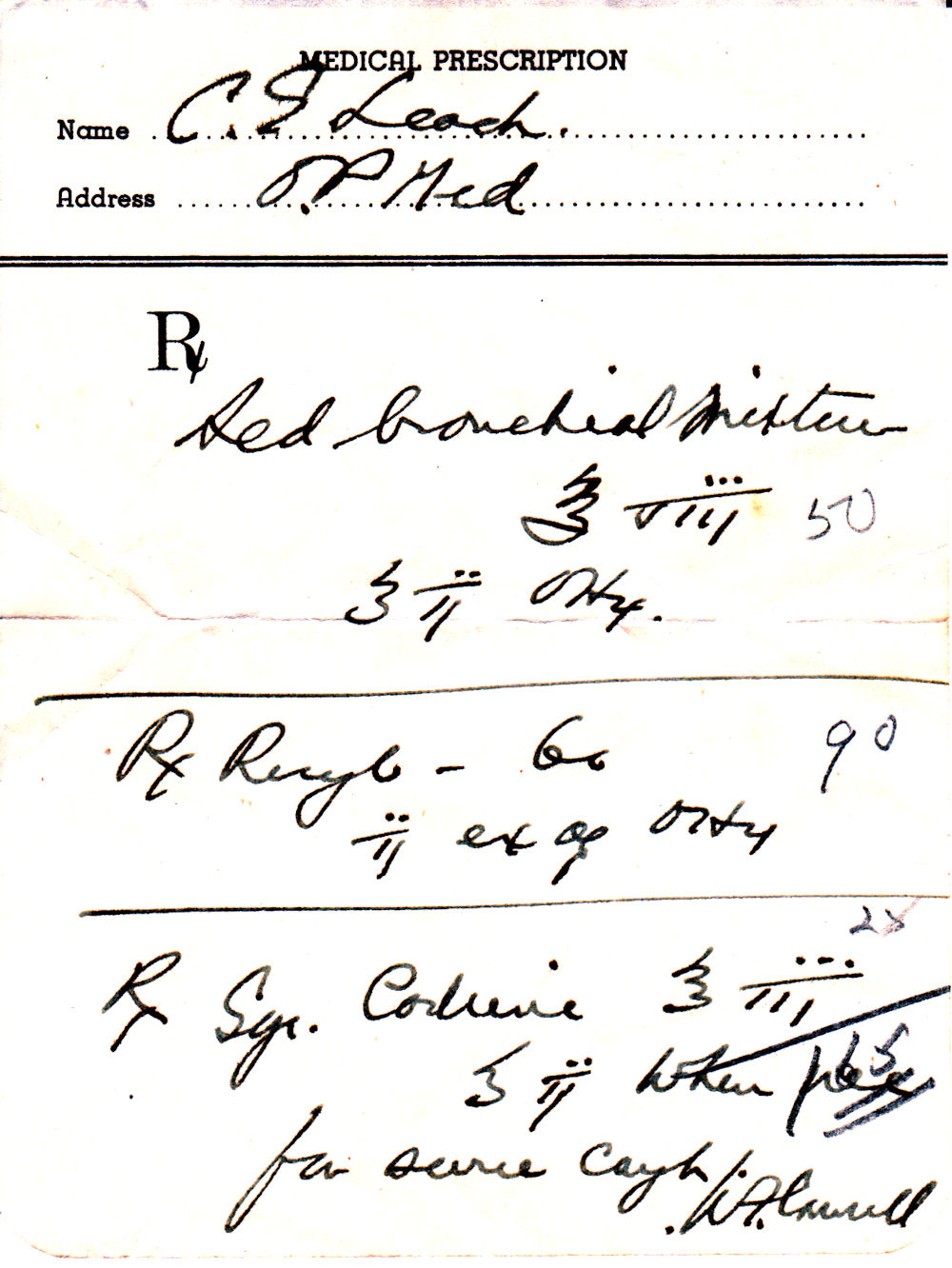
Charlie thanked Dr. Connell, and, because he liked to pay promptly, settled the bill for his visit directly with Dr. Connell.

On his way home Charlie picked up his medications. Their total cost was $1.65. Now it is common to quote prices from "the old days" without adjusting them to reflect cost of living and purchasing power in the time period they took place. Charlie was a dairy farmer so one comparison would be that the retail price of milk at the time was about 60 cents a gallon. The price of milk in 2011 is approximately 7 times what it was in 1945. Therefore, the total cost to Charlie of his medical adventure had been $20.65 or about $150.00 in current funds. In return, Charlie had seen (promptly and on time) a family doctor who actually knew his family, been referred in less than one month to the top cardiologist in the area, had had a x-ray and paid for three medications.
Charlie farmed for another 20 years. His cough was never "cured" but that was because he was a heavy smoker. That didn't help the heart either. Less than two years after he retired, he succumbed to a heart attack, aged 70. Charlie Leech was my father-in-law and coming across these documents in some old family papers caused me to reflect that perhaps health care was not so bad, back in the day.
Subscribe to:
Posts (Atom)