Thursday, July 14, 2011

Rural Development in Chains?

A FB friend recently lamented the arrival of Tim Horton's in Nipawin, SK.  Part of the argument was a distaste for the products and ambiance of Tim's.  The other part of the argument was that familiar to the anti-Wal-Mart element, about how big chains would over power the local merchants.  As someone interested in rural development, I had the following thoughts:

  1. Choice. If one doesn't like Tim's, one has the option of not attending the premises.  I, too, find the appeal of Tim's illusive.  I find them too small, usually not very clean, and the service level unpredictable.  Then again, I don't like coffee. However, whenever I do accompany my wife to one, it is invariably full of folks who seem to be enjoying their experience.  I suspect the same thing will occur in Nipawin.
  2. Jobs.  One of things rural communities need is jobs.  Tim's will provide these - all the way from part-time high schoolers up to the franchisee.  [The franchisee is often forgotten.  Here is someone bravely betting that they can create, manage, and sustain a local business.  One of their main challenges will be finding enough people (among those who claim to want "jobs") who can be sufficiently motivated to show up punctually and regularly, and deliver a level of customer service which will sustain the business.  I wish them well.]
  3. Opportunity. The other businesses in town in similar lines have the opportunity to compete on the basis of quality of product and level of customer service.  As mentioned above, Tim's has their vulnerabilities.  Perhaps, the local bakery can put in a couple of tables, brew some good quality coffee, and welcome their customers to "set a spell" and have some fresh baked goods with their coffee, or tea.  Is there a market for a tea house, for those who find Tim's a glorified cafeteria?  The other area of opportunity is in increased clientele for all.  Like Wal-Mart, I suspect Tim Horton's in Nipawin will bring in new customers from a wider geographic area and bring existing customers out more often.  Studies and experience have shown that this is usually the result of an addition to a community's retail sector.  It is the phenomenon that some call "increasing the size of the pie" rather than assuming there will be increased competition for a fixed sized customer base.
  4. Affordability.  I grew up in Lloydminster in the days before "the chains" came to town.  Groceries, for example, were provided by a couple of independents and the local Co-op.  Prices were always 10 - 15 % higher than in Edmonton, service was unpredictable, especially if you were not one of the in crowd, and some of the produce [especially at the Co-op) was of such poor quality it had no business being on the shelves.  So, we welcomed the day when Safeway came to Lloydminster.  Thanks to intelligent management, the Co-op eventually reacted and now-a-days competes well, including having a range of fresh produce which doesn't take a back seat to any of its competitors.  All of this is an example that overall, the cost of living improved because prices went down and the quality of products and services went up.  The same can happen in any small town - including Nipawin.

So, in conclusion, I say welcome to Nipawin, Timmy.  The vast majority of folks will find you a positive addition to the community, even if you are not exactly my cup of ... er  ... coffee.


Sunday, July 10, 2011

Health Care in Canada - 1945

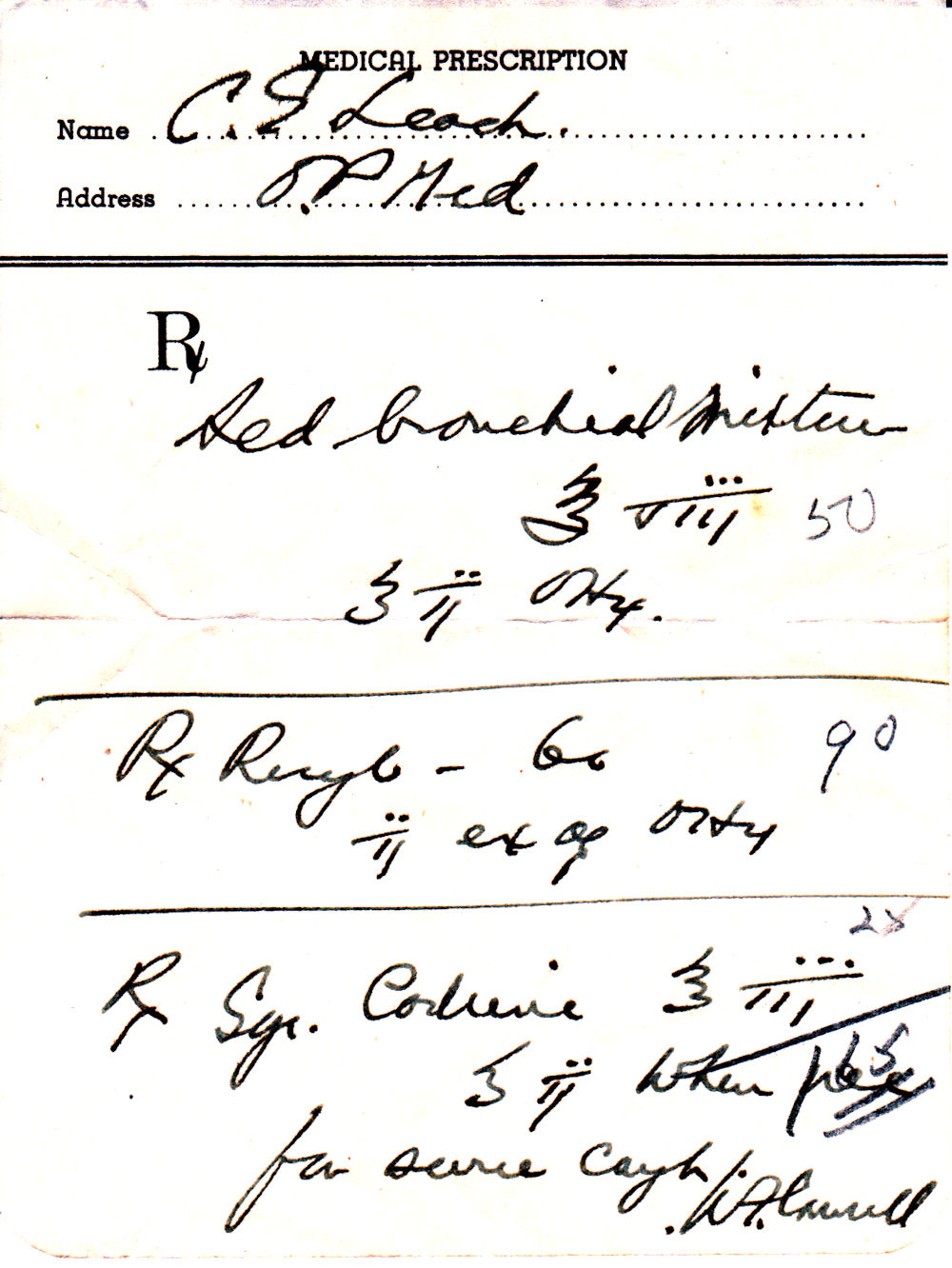
Charlie Leech was a dairy farmer who lived near Newboro, Ontario in 1945.  He worked hard to support his family, milking more than 20 cows twice a day, growing corn, haying and doing all the other chores on a family farm.  In addition that spring, his mother had died and he had been the one to take care of all the matters of the estate.  Worn down perhaps, he developed a bad cough and the periodic chest pain he experienced became more severe. On May 19, 1945, he went to visit the family's doctor in nearby Westport, Ontario.

This was in the days before Canada had a "free" "Health Care" system so Charlie had to pay $3.00 for the office visit.  Dr. Goodfellow was troubled by the increasing chest pain and recommended Charlie see the best cardiologist in the region, Dr. W. Ford Connell at the Kingston General. So, on June 13, 1945, Charlie drove in to Kingston and met with the well regarded specialist.  Dr. Connell did an examination, talked to Charlie about his family, extended his condolences regarding Charlie's mother, and sent Charlie down stairs for a chest x-ray.  That cough was a miserable one too.  Charlie paid $6.00 for the x-ray.


Back he went to Dr. Connell who wrote a prescription for three medications to deal with both the cough and the chest pain. 


 Charlie thanked Dr. Connell, and, because he liked to pay promptly, settled the bill for his visit directly with Dr. Connell.

On his way home Charlie picked up his medications.  Their total cost was $1.65.  Now it is common to quote prices from "the old days" without adjusting them to reflect cost of living and purchasing power in the time period they took place.  Charlie was a dairy farmer so one comparison would be that the retail price of milk at the time was about 60 cents a gallon.  The price of milk in 2011 is approximately 7 times what it was in 1945.  Therefore, the total cost to Charlie of his medical adventure had been $20.65 or about $150.00 in current funds.  In return, Charlie had seen (promptly and on time) a family doctor who actually knew his family, been referred in less than one month to the top cardiologist in the area, had had a x-ray and paid for three medications.
     Charlie farmed for another 20 years.  His cough was never "cured" but that was because he was a heavy smoker.  That didn't help the heart either.  Less than two years after he retired, he succumbed to a heart attack, aged 70.  Charlie Leech was my father-in-law and coming across these documents in some old family papers caused me to reflect that perhaps health care was not so bad, back in the day.

Saturday, July 2, 2011

Health Care debate growing

     There was an interesting exchange on Twitter last evening between Doug Griffiths, (@GriffMLA) MLA  and Progressive Conservative (PC) leadership candidate, and Rob Anderson,  (@RAndersonMLA) MLA and Wildrose Alliance (WR) insider, about the "health care" situation in Alberta. While Twitter is not the best medium for a sustained, in depth debate, it was refreshing to see some potential political heavywights engaged in a probing examination of where we are and what might be done.
     One of the things that initiated the debate was Griffiths' recent suggestion that health care premiums be reintroduced.  Anderson countered that "premiums won't do squat to fix our system".  Griffiths conceded that "Health needs many [other] reforms" but wondered how we are going to pay for the ever growing cost of our present system.
     I agree that reintroducing premiums is definitely not an answer, especially if there is no fundamental change in the philosophy and processes characteristic of our present "system".  On the other hand, Anderson's contention that "family docs are All private providers competing for publicly insured patients", as an example that we already have an element of private enterprise in our system, suggests a superficial analysis.  There is a huge difference between competing for fully autonomous customers (i.e. where patients control their own funds) and "competing" for government funding, which is a political process.
     Perhaps the major problem with our "health care system" is that it has become entirely "political".  What does that mean?  Over my years of teaching political science, I developed an excellent definition of politics as "the struggle for the power to set the rules for a society".  The key word in this definition is "power".  There are many sources of power.  Among them are influence and money.  Influence can change the rules of a society by, say, allowing PC insiders to jump health care queues. Money can change the rules by allowing the wealthy to fly to the Mayo clinic for an MRI they would have to wait months for in Alberta.
     As usual, the key to understanding a situation is to "follow the money" and especially the power to control the money.  One of the most corrupting characteristics of a "political" system is that a few insiders are able to control the money of others.  Taxation, we need to be reminded, is the confiscation of one person's money by a state apparatus which allows that money then to be spent by others for their own purposes.  Health care premiums are simply another tax (i.e. confiscation of money).  One attractive element of the WR position is that it proposes "funding following the patient" which one hopes means that the individual would be able to control how their funds are expended. Such a system would allow more of the private enterprise approach which, as it operates in, say, the food industry, would allow truer competition which, in turn, tends to allow the improvement of customer service and product quality.  There can only be competition if there is real choice by "clients" who have true power to control their own money.
     On that topic, we need much more transparency.  Whatever happened to informing us about what money is actually being spent on our behalf in health care?  In the early days of "health care" we would get an annual statement of what funds had been spent on our account, itemizing, for example, how many visits we had made to doctors and the charges associated with each visit.  Why do we no longer get this information?  Who audits doctors?  Are we to believe that no doctor in Alberta ever bills for a phantom patient visit?  I haven't heard of one, have you?
     In summary, we need to re-examine our basic assumptions and processes.  The Anderson - Griffiths exchange is a mildly encouraging example of that.  I see that @RajShermanMLA has also challenged "any/all PC candidates to a healthcare debate".  The more we engage in probes of our existing situation the more likely we are to correctly diagnose its problems and the more likely we can prescribe some remedies that will lead use to a healthier economic and political condition in our Alberta.

Friday, June 24, 2011

U of A follow-up

      Well - the U of A response to the plagiarism issue (see post below) earns a C.  Fairly prompt - the Dean resigns - BUT only as Dean.  He remains in faculty and, after a summer off, will resume teaching duties in the fall.  Financial and other "penalties" seem minimal.  One wonders, for the sake of balance, how many medical / dentistry students were penalized for plagiarism in the past year?  What was the nature of those penalities?  Is this a case of fairly harsh penalties on paper morphing into cautious wrist tapping when applied in individual cases.  Enforcing rules always takes courage (the courage to be seen as "not such a nice guy") but it is enforcement which has the most impact on culture. 
     I worked in a school once where one or two teachers parked in the few stalls designated for visitors, perhaps because they were close to the school entrance.  The response of administration was: general memos read over the PA system "all those parking in the visitors parking spots should refrain from doing so" to increasingly larger signs being posted "Visitor Parking Only".  The culprits kept parking while the innocent resented being berated for something they were not doing.  How much more effective it would have been for the principal to go to Larry and Mo (they were easily identified as the offending parkers) and say "Stop parking in the visitors or your cars will be towed" and then making sure that the next time they parked there - the tow trucks were called immediately.

Thursday, June 16, 2011

A Test for the U of A

   Recent accusations of plagiarism against a Dean at the University of Alberta ( http://www.edmontonjournal.com/life/Accusations+cast+pall/4941801/story.html ) raise a number of interesting issues. One of those is the manner in which power corrupts democracy.  In all organizations, power accrues to the administration.  Bureaucratic processes are used to obfuscate the exercise of power by a small inner cadre of administrators.  Stakeholders are fed myths about the "mission, vision, and values" of the organization which, especially in crises situations, are revealed as propaganda and spin.  Thus, when, say, downsizing the organization, individuals will be axed in indirect proportion to their power.
   So, the test for the University of Alberta is whether it will deal with the Dean of Medicine and Dentistry in the same way it would deal with Joe Student from Hairy Hill.  Already, the answer is apparently "No." as the Dean's fake speech issue must be "carefully studied" and all the bureaucratic arsenal of delays, hair splitting, and contextual concerns are deployed to provide time for the issue to blow over and attention be turned to the next cause celebre.
   Why this rankles is that there is a strong urgency for fairness in a culture which is truly democratic.  So called rebels, from Thomas Jefferson, to Wael Ghonim, and Julian Assange - have all been motivated, in large part, by experienced and perceived unfairness in the treatment meted out to the less powerful as compared to the arrogant dismissal of fairness and similar values by those in positions as insiders of the power elites.
   Will the U of A pass the test?  That will depend on its scores on the following rubric: fairness, transparency, accountability, openness, promptness, and courage.  Will "whatsoever may be true" become a reality - or will it be reserved for the next opportunity to inspire students or motivate alumni givers?
  

Friday, June 10, 2011

Great article on Alberta "Health Care" by Kevin Libin

     Today's National Post (p. A8) included an insightful article by Kevin Libin about Alberta's failing "Health Care" system.  While the article gives a lot of attention to the recent revelations about queue-jumping by political insiders, and leans a bit too hard on the "corrupt Alberta P.C.'s" angle; a thoughtful reading confirms some of the basic symptoms of our "Health Care" malaise. It also further justifies my comment years ago, in Vermilion, to then Health Care Minister Gary Mar, that we had a Soviet Style health care system.  Mr. Mar dismissed my comment as a bizarre bleep from an awkward non-entity.  However, Libin's article highlights that, just as in the "egalitarian" Soviet Union, while peasants and workers were queueing for hours to access poor quality, superciliously delivered food staples, Communist party insiders had special access at the GUM department store where they could promptly obtain high quality and exotic items, in special venues reserved for them.  All the while, these same Soviet officials touted the myth that everyone in the Soviet Union was an equal "comrade".      Now, to me, the parallels between this Soviet reality, and the current state of Canadian "Health Care" are striking.  So, the problem is not that somehow we have some corrupt, or arrogant, or incompetent politicians, or bureaucrats.  The problem is that we have politicized health care and removed the patient from any control over the quality or the attitude with which health care is delivered.  We wouldn't put up with the quality of "customer service" in any other aspect of our lives.  We know that many people will play the system to their advantage if they can so it is not just that we have "tory insiders" it is that when you have a politically driven system, it guarantees that insiders will acquire more power and use it to their own advantage.  We need to move to end the state controlled monopoly which enforces long queues and low quality for the masses and invites political insiders to abuse their power.
     Another encouraging comment in Libin's article is that more and more Albertans are becoming aware of the disconnect between the propaganda claims that "we have the world's greatest "Health Care" system [just look at the billions we spend on it]" and the reality of unsustainable costs, continually deteriorating quality, and appalling attitudes of many burned out health care professionals.  One hopes that we do not have to wait for every Canadian to experience first hand the horrors of emergency room waits, unsanitary hospital wards, or bored arrogance from doctors, before we realize that revolutionary changes are needed.  It took a long time in the Soviet Union but eventually the disconnect between the myth spun my Communist party officials compared to the reality experienced by long suffering ordinary "comrades" was just too great to be sustained.  The iron curtain fell.  Hopefully, Canadian "Health Care" will soon follow.

Friday, May 6, 2011

Time to get serious about fixing "Health Care"

     During the recent election campaign, all parties supported increased spending on "Health Care" despite the fact that such spending may have already reached unsustainable levels.  More serious even than the financial implications is the degree to which our "Health Care" system has eroded the quality of care and respect for the individual humanity of each "patient".  We are all familiar with stories of months on waiting lists, hours in emergency rooms, squalid unsanitary conditions on wards, burned out staff treating patients like annoying interruptions, and doctors consistently overbooking office visits with absurd rules such as "only one complaint per visit". 
     Despite all of this (and much more) we still hear Canadians claiming we have a marvelous system that we need to protect at all costs (literally, apparently).  It's long past time to admit, our "Health Care" system is broken and corrupt and needs to be fixed to improve patient care, health outcomes, accessibility, staff morale, and financial sustainability.  It is also past time to recognize that spending more money without significant changes in philosophy and culture is only compounding the problems.
     With this in mind, it was not encouraging to hear PM Harper's post election comments which seemed more concerned with placating the "friends of Medicare" than treating the sickness of our system.  Some suggest that somehow the recent election has empowered the West, or, alternatively, long-suffering conservatives.  I'm not optimistic that we have set the stage for meaningful reform.  I think we still have some hard campaigning to do and can expect strong push-back to efforts to administer the strong medicine needed to cure our "Health Care" system.  Rather than try and nudge our Conservative MPs toward "Health Care" reform, I think we should fight for reforms at the provincial level (which actually has the constitutional jurisdiction for health). 
     In Alberta, we have a promising alternative in the proposals of the Wildrose.  [see more here and especially here].  The Wildrose recognize the severity and scope of the problem, and that attempting to fix these problems will require courage and innovation.  I am particularly heartened by the direction of shifting power to "the patient" by, for example, having funding follow the individual rather than the current top-down, bureaucratic, politicized models.  If we accomplish meaningful reform in Alberta, it will hearten those in other provinces to follow our lead.  We should be fully prepared for resistance to our efforts from the federal "conservative" government.  However, Alberta has fought such fights before and the results have not only benefited Albertans but ultimately all Canadians as well. 
     It is a far more serious situation than even those of us concerned about it realize.  There was talk of Alberta addressing the problems about 10 years ago - even to the point of opting out of the Canada Health Act.  Unfortunately, we caved on that.  Since then we have subsidized a sick system with billions of our allegedly "dirty dollars".  Let's keep our dollars in Alberta, fix our system, and demonstrate to all Canadians what a sound, healthy and effective "Health Care" system would really look like.